
Ever ring a signwriter and feel like they are speaking a different language? You want privacy on your boardroom glass, or a logo on the front door, or "that frosted look" on the meeting room, but you have no idea what any of it is called. That is completely normal. After 20 years in the industry, I hear the same phrases over and over: "the cloaking stuff," "the frosty film," "the sticker thing." So here is a friendly A-to-Z that decodes every term you might see on a quote or hear on a site walk, with a plain example of what people usually want when they use it.
Read straight through, or jump to a section:
Glass & frosting: what all those "frosty" words actually mean
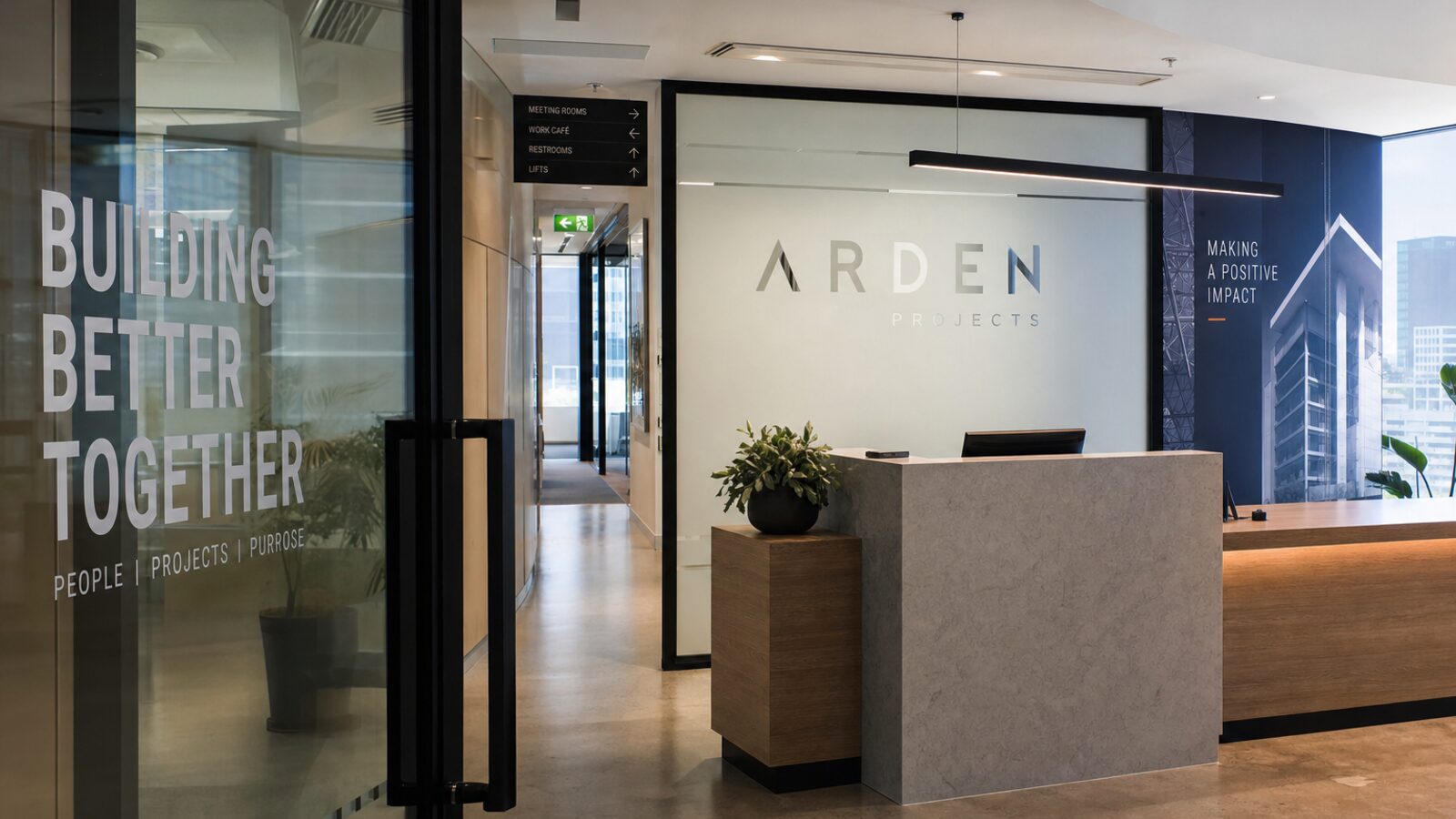
This is the most confusing category by far. There are six or seven names people use for essentially the same product, plus a few for related but different things. If you take one thing from this guide, let it be this: frosting, cloaking, privacy film, dusted crystal and etch effect are all describing vinyl film stuck to glass. The differences are usually pattern, brand and price, not category.
Window frosting
Also called: frosted film, privacy film, etch film, dusted crystal, opaque vinyl
An adhesive vinyl film applied to existing glass that turns it from clear to translucent. Light still passes through, but you cannot see clear detail through it. Removable, replaceable, no glass replacement needed.
You probably want this if: you can see straight into a meeting room, office or bathroom and want privacy without renovating.
Cloaking
Also called: cloaking film, cloaking vinyl
An informal Australian nickname for privacy film, more common on building sites than in showrooms. Some tradies call all frosting "cloaking." It usually refers to the same product as frosting, just under a chattier name.
You probably want this if: a builder or shopfitter told you "we need cloaking on the boardroom." They mean privacy film.
Dusted crystal
Also called: crystal effect, satin frost, matte white
A specific look within the frosting family, usually the standard "cleanest" white translucent finish. When someone says "just the plain frosted look," they usually mean dusted crystal.
You probably want this if: you want a modern, clean, uniform frosted appearance with no pattern.
Etched effect
Also called: etch vinyl, sandblast effect, acid-etch look
A film that mimics the appearance of sandblasted or acid-etched glass. Costs a fraction of real etching and looks nearly identical from a normal viewing distance. Removable if you rebrand or move.
You probably want this if: you love the look of etched glass but do not want to permanently alter the panels.
Cut-to-pattern
Also called: custom cut frosting, pattern cut, logo cut
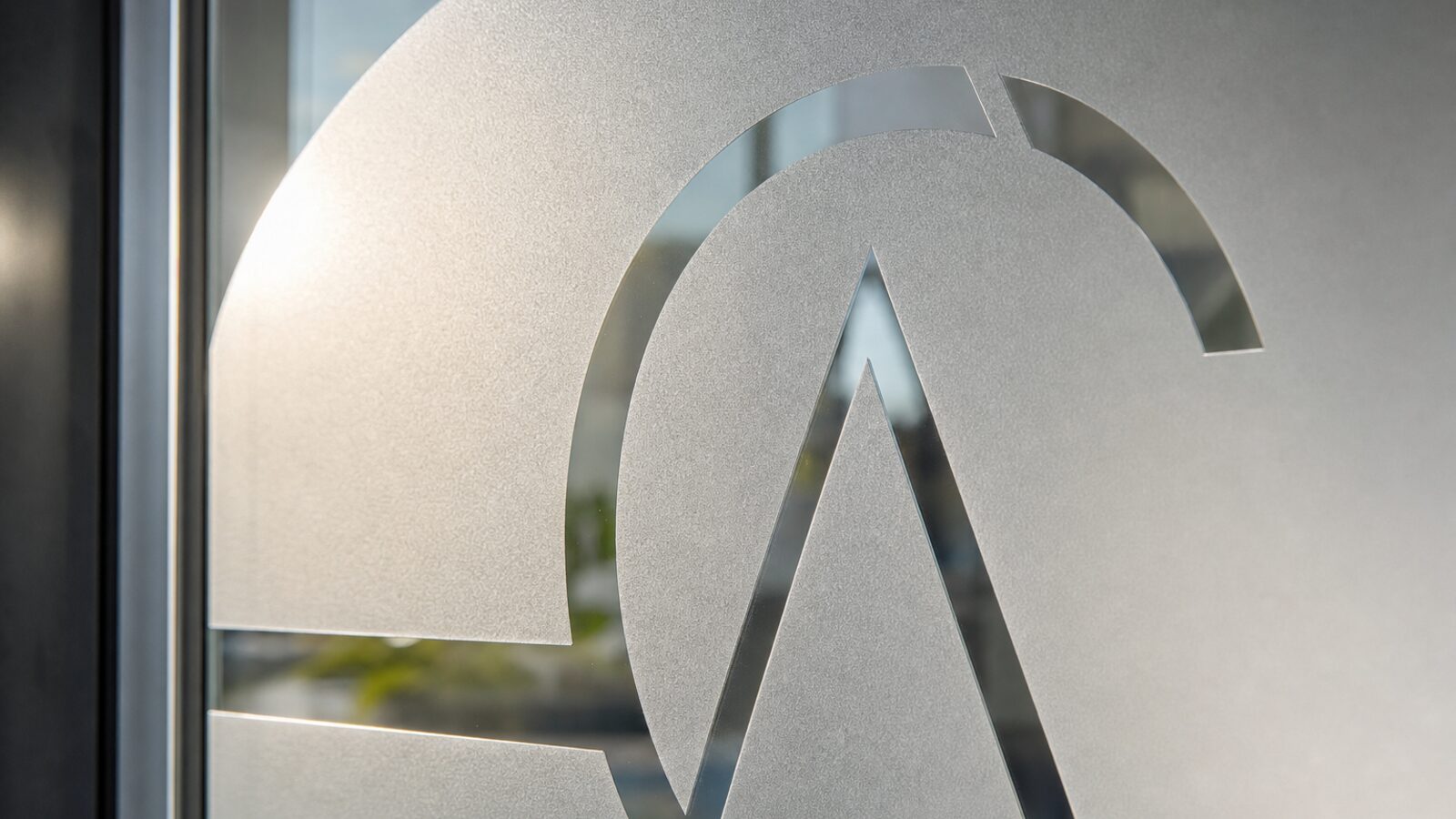
Frosting film cut into a specific shape, pattern or logo rather than applied as a full sheet. Common for reception logos on glass entry doors, or decorative bands with brand shapes cut through.
You probably want this if: you want your logo, a decorative pattern or a company name to appear "in the frost."
3M Fasara
Also called: architectural film, decorative glass film, pattern film
3M's premium architectural film range. Comes in dozens of decorative patterns (linear, dot, geometric, textile-inspired). Costs more than generic frosting but has 3M warranty backing, sharper visuals and much longer life expectancy.
You probably want this if: the space is high-visibility, the brand is premium, or the specifier has already asked for "Fasara" by name.
One-way vision film
Also called: perforated vision, see-through vinyl, one-way graphic
A perforated film that shows a printed image on the outside while still letting people inside see out. Very common on shopfront windows, buses and glass doors. Not a privacy film in the traditional sense: at night with interior lights on, the "one-way" effect reverses.
You probably want this if: you want a big printed shopfront graphic without blocking your staff's view of the street.
Logos & graphics: signage on glass, walls and doors
Wall graphics
Also called: wall vinyls, wall murals, wall wrap
Printed vinyl applied directly to interior walls. Can be a photographic mural, a hero quote, a full-wall brand pattern or a subtle repeat design. Removable in most cases without damaging paint if applied over a properly cured painted surface.
You probably want this if: the reception, breakout or meeting room walls feel bare and you want a hero visual without hanging framed art.
Feature wall vinyl
Also called: hero wall, statement wall, brand wall
The same as wall graphics but usually referring to a single dramatic wall, often behind reception, with a large-scale image or brand statement. Common in fitouts and often the first thing visitors see.
You probably want this if: you have one wall that visitors face when they walk in and you want it to make an impression.
Cut vinyl lettering
Also called: cut letters, vinyl signage, name lettering
Text or logo shapes cut from coloured vinyl and applied directly to a surface (glass, wall, door). No printed background: just the shape itself. Used for reception logos on glass, company names on entry doors, and directional lettering on painted walls.
You probably want this if: you want your logo or business name applied cleanly and clearly to glass or a wall.
Printed vinyl
Also called: digital print, full-colour vinyl, printed graphics
Full-colour printed vinyl on a self-adhesive backing. Used when a design needs photographic imagery, gradients or complex colour rather than a single flat colour.
You probably want this if: your artwork has photos, gradients or more than two or three colours.
Reception logo
Also called: reception sign, wall-mounted logo, foyer sign
A logo or wordmark installed on the wall behind reception. Can be cut vinyl (flat, cost-effective), acrylic or aluminium letters (dimensional, higher-end), or a printed panel. Nearly every commercial office has one.
You probably want this if: you want a professional logo installation to greet visitors, on either the reception wall or the entry glass.
Signage types: what actually goes on the building
Shopfront signage
Also called: exterior signage, façade signs, retail signs
Any signage visible from the street: fascia signs above shopfronts, window graphics on the glass, projecting blade signs, awning signs, freestanding pylons. Usually the highest-visibility sign a business has.
You probably want this if: you have a physical location and want people walking or driving past to know who you are.
Fascia sign
Also called: fascia panel, shop sign, banner sign
The main horizontal sign that sits above a shopfront, running the width of the storefront. Can be printed panels, illuminated letterboxes, or dimensional letters mounted to a fascia.
You probably want this if: you are fitting out a retail or hospitality space and need the main name sign above the door.
Awning signage
Also called: awning wrap, awning graphics, canopy signs
Signage applied to or hanging under an awning, common in Sydney where awnings are ubiquitous on inner-west and CBD shopfronts. Includes underside "look-up" signs, edge banners and wrap graphics.
You probably want this if: your building has an awning and you want to make it work harder as a sign.
Wayfinding
Also called: directional signage, navigation signs, wayfinding system
The signage system that helps people find their way around a building. Includes room number plates, directional arrows in corridors, floor markers, level identifiers in lifts and stairwells, and lobby directories.
You probably want this if: you are fitting out an office over multiple rooms or floors and need visitors, staff or tenants to navigate.
Room ID signs
Also called: door signs, name plates, meeting room signs
The small signs on or beside each door identifying the room. Can be simple engraved plates, printed acrylic tiles, or magnetic changeable panels for meeting rooms that are booked dynamically.
You probably want this if: you have named meeting rooms, offices or amenities and want them clearly labelled.
Vehicle signage
Also called: vehicle graphics, fleet wraps, van signage
Vinyl graphics applied to work vehicles, ranging from a simple logo and phone number to a full colour wrap. Cut vinyl for basic identification, printed vinyl for photographic or full-colour designs.
You probably want this if: you have a work vehicle that could be earning brand impressions every time it drives around.
Compliance: signs the law requires
Glass manifestation
Also called: manifestation strip, safety banding, BCA glass markings
Visible markings on large glass panels required under the National Construction Code (BCA) to make the glass visible so people do not walk into it. Most commonly a horizontal band of dots, lines or a logo applied at eye height. If you are doing a fitout with big glass partitions, you are almost certainly required to have this.
You probably want this if: you have full-height glass walls, glass doors or big glass partitions in a commercial space. See our glass manifestation explainer for more.
Statutory signage
Also called: statutory signs, code signs, compliance signage
Signs required by law rather than by choice. Includes exit signs, fire equipment location signs, accessibility symbols, evacuation diagrams, first aid signs and hazard signs. Building certifiers check these on handover.
You probably want this if: your fitout is being certified and you need every code-required sign in place before final sign-off.
Exit signs
Also called: illuminated exit, running man signs
The green-and-white illuminated signs above every fire exit. Not usually a vinyl signwriter job (electrical), but they get grouped with statutory signage on fitout schedules.
You probably want this if: you are looking at your statutory signage list and wondering what "running man signs" means.
Accessibility signage
Also called: DDA signage, tactile signs, braille signs
Signs that meet Disability Discrimination Act and AS 1428 requirements. Includes braille and tactile characters on room signs, accessible toilet signage, hearing loop symbols and wheelchair accessibility markers.
You probably want this if: your building must meet DDA compliance and your certifier has flagged tactile or accessibility signs on the drawings.
Materials: what your signs are actually made of
Vinyl
Also called: sticky vinyl, self-adhesive vinyl, sign vinyl
The catch-all material for almost everything discussed above: thin, flexible, self-adhesive plastic that comes in coloured rolls (cut vinyl) or printable white rolls (printed vinyl). Rated for indoor or outdoor use, and short-term or long-term durability.
Acrylic letters
Also called: laser-cut acrylic, perspex letters, dimensional letters
Letters or logo shapes cut from acrylic sheet, typically 5-10mm thick, mounted on standoffs or flush to a wall. A step up in presence from cut vinyl. Often used for reception logos where dimensionality matters.
You probably want this if: you want a reception logo that reads as a "3D" installation rather than a flat vinyl decal.
Aluminium letters
Also called: metal letters, alu letters, brushed metal signage
Letters or logo shapes fabricated from aluminium, often with a brushed or painted finish. Premium look, longer lead time than acrylic, higher price point. Common in corporate lobbies and legal or finance office receptions.
ACM (Aluminium Composite Material)
Also called: Alupanel, Dibond, composite panel
A rigid panel made of two thin aluminium sheets bonded to a plastic core. Used for external fascia signs, freestanding panels and directory boards. Weatherproof, flat, prints beautifully.
You probably want this if: you need a rigid, weatherproof external sign panel with a printed graphic.
Corflute
Also called: corrugated plastic, real estate sign board
Lightweight corrugated plastic sheet used for short-term signage (development site signs, real estate boards, event signage). Cheap, disposable, not for permanent installation.
Install terms: what your quote actually covers
Wet application
An installation method where a soap-and-water solution is sprayed onto the glass or vinyl to allow the installer to slide it into position before squeegeeing out the water. The standard technique for large glass panels and frosting films.
Dry application
An installation method with no fluid, where the vinyl is aligned and applied directly. Used for cut vinyl lettering, most wall graphics and precision small graphics where a wet method would cause registration issues.
Squeegee
The flat blade tool used to press vinyl onto its surface and drive out air bubbles or installation fluid. Different edges (felt, plastic, hard, soft) are chosen for different films.
Registration
The alignment of a graphic on the substrate: how straight, how centred, how consistent panel-to-panel. Poor registration is the number one visible sign of an amateur install. Good registration is invisible: you just notice the room looks right.
Squared / plumbed
The graphic is level (squared to the horizon) and vertical (plumbed to gravity). On glass partitions and shopfront signs, if a graphic is not squared and plumbed, the eye picks it up instantly.
Butt join
Where two adjacent vinyl panels meet edge-to-edge with no overlap. Skilful butt joining on wide frosting installations makes a multi-panel run look like one continuous film.
Overlap
Where one panel of vinyl overlaps the next slightly. Faster than butt joining but visible under raking light. Usually avoided in commercial frosting where a seamless look is expected.
Substrate
The surface the vinyl is being applied to: glass, painted wall, ACM panel, aluminium panel, timber, etc. Different substrates require different films, adhesives and preparation.
Removal
The process of taking off existing vinyl or film. Old, weathered or heat-cured vinyl can be much harder to remove than fresh. A good removal quote factors in the age, exposure and adhesive residue clean-up. Rebrand jobs almost always involve removal work.
Quick cheat sheet: "I want ___, but what do I ask for?"
If you skim only one section, make it this one:
- "I want privacy on my glass meeting rooms." → Ask for frosting or privacy film. If you want a pattern, ask for Fasara.
- "I want my logo on the entry door." → Ask for cut vinyl lettering or a cut-to-pattern frosted logo if you want the logo in the frost.
- "I want a big graphic on the reception wall." → Ask for a wall graphic or feature wall vinyl.
- "My builder said we need cloaking." → That is privacy film, same as frosting.
- "My certifier said we need dots on the glass." → That is glass manifestation, a BCA requirement.
- "I want to look expensive in reception." → Ask for acrylic or aluminium letters instead of cut vinyl.
- "I want a shopfront banner." → Ask for a fascia sign. If it hangs from the awning, ask for awning signage.
- "I want my van signed up." → Ask for vehicle signage. Cut vinyl for basic, full wrap for maximum brand.
- "I want to see out but people can't see in." → Ask for one-way vision film. Note: reverses at night with lights on.
- "I want the old signs off." → Ask for a removal quote, especially if the vinyl is more than 3-5 years old.
Still not sure? Ring or email.
The single fastest way to know what you actually want is to send a couple of photos. If you snap the space on your phone and email it through, you will usually get a "you probably want X, here is roughly what that costs" reply the same day.
No jargon, no upsell, no obligation. If you are earlier than that and still just trying to understand your options, this glossary should be enough to make the first conversation with any signwriter far less confusing.